
Innovation, the word that makes some people’s eyes light up with excitement and others tremble with fear. It’s both the inevitable and the fiercely resisted. One way or another innovation is going to bring change into your life. And in an ever-changing world of new and emerging technologies combined with exciting and confusing buzz words how do you know what is good innovation, when innovation is too much and when innovation can be ignored?
New and emerging technologies, disruptive competitors and obsolete business models are all a risk to practically every organisation and should be considered a top strategic priority of all business leaders. Despite these existential risks it can be difficult to get the kind of attention these risks deserve within your organisation partly due to the complexity of trying to quantify these risks and partly due to apathy for the status quo. It certainly appears to have an outsized effect on large enterprises with large market share, perhaps due to lack of knowledge, lack of vision, or the difficulty in turning/changing such a large enterprise or. Either way, the risks remain and many a large enterprise with a large market share have succumbed to the disruptive innovator.
This situation is known as the “innovator’s dilemma” a term popularised in the book by Clayton M. Christensen, The Innovator’s Dilemma. Christensen explores the ways in which technology disruption causes even the greatest organisations to fail, despite the best efforts of these organisations to innovate.
Take for example Nokia, the biggest mobile phone manufacturer in the world at its peak. While Nokia was busy making their phones smaller or jazzing up their existing phones with new styles, they ignored emerging touch screen technologies. If you’re old enough, you’ll remember the impracticality of trying to type out a text message on a tiny little keyboard of the 8210. Enter iPhone – the phone that changed the game forever! Gone was the tiny little physical keypad while the full touch screen QWERTY keyboard was reinvented (no, the ones that required a stylus don’t count!). Text messaging was easier, but it also brought a whole new array of capabilities that were unthinkable previously – full page internet browser, useful apps, full colour modern games, a decent digital camera and an integrated music player. How did Nokia get left so far behind so quickly!
This leads to the concept of “sustaining innovation”. The new iPhone was bigger, heavier and you were lucky to last a day without needing to recharge your phone, but it didn’t matter to customers, they loved the new capabilities. Nokia focused on making their phones smaller, lighter and had a battery that could last a week without charging – in other words they innovated to sustain the existing technology. By ignoring emerging technologies and not anticipating customers changing expectations Nokia focused on over innovating its current product, they put the blinkers on and only focused on how they could make their existing product better rather than looking how they could evolve their product to keep up with technology and customers.
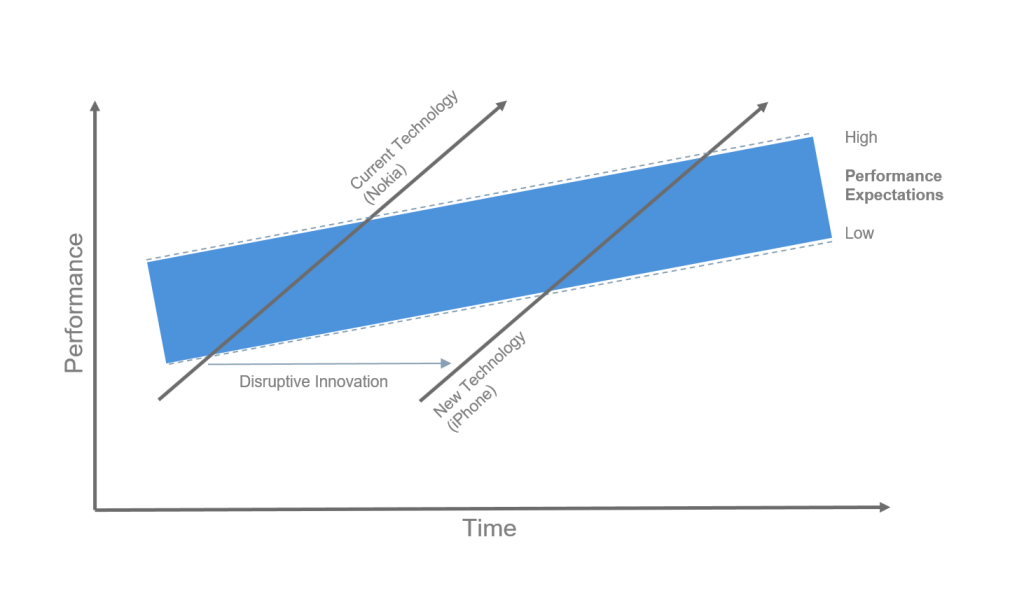
The diagram below illustrates the sustaining innovation effect and how companies can spend too much time “wasting” their innovation efforts by providing capabilities customers don’t really need or want. They “overshoot” their customer expectations while a disrupter progresses to the next evolution of a product. Over time customers’ expectations of performance increase and eventually a disruptive product comes along and meets those growing demands while superseding the previous product. In Nokia’s case, how small can a phone get before it’s impractical, how much battery life do you really need when you can charge every night. It turned out people were much more willing to sacrifice size, weight and battery life for the far greater capabilities of the iPhone.
Although we are talking about technology companies here the same kind of risk can affect your organisation as well, and I have seen plenty of examples. I’ve spent time working with organisations who often complained about their decreasing margins and difficulty winning new customers. Rather than look to innovation as a possible solution they fall back to the status quo by cutting costs or lowering staff numbers leading to poorer quality outcomes. This can be because the changes that organisations require are challenging and disrupt their existing business models; operational, financial, delivery or pricing. Organisations need to be expertly guided through this process.
A common enterprise technology scenario I’ve experienced is the “proprietary” data platform, the one that is well past it’s used by date (if it ever was fit for purpose), does half the functions the organisation actually requires and is locked into some language format that doesn’t translate to any other platform. What tends to happen in these situations is instead of evolving to a new platform that will more closely align with their needs, they double down on the existing platform spending way too much cost and effort persisting with a solution that is simply far behind what is possible with other solutions.
The common denominator between the enterprise data platform scenario and the Nokia scenario is the sole focus on the product rather than the best way to serve your customers/organisation. This myopic view of the existing product is what leads to the competition pulling ahead and eventually superseding the incumbent. In an enterprise sense, this is how your productivity begins to lag behind with costs increasing, customers leaving, and higher employee turnover.
Sometimes I have successfully overcome this paralysis to evolve, other times I have not been successful or found some success only to find another battle of complacency elsewhere which threatens to derail it all.
To successfully engage and ultimately deliver innovation in your organisation you need a multi-pronged approach that anticipates the various excuses and brick walls you will come up against. Here are some of the techniques I have used to deliver successful innovation:
- Always position the outcome – don’t get caught in the product focus trap, position your innovation with the organisational outcome in mind – the technology is just the means to the end and if it needs to change or evolve to achieve those goals then it just becomes second nature.
- Authority – getting buy in from a very senior figure in your organisation can assist you to get much needed approvals and politely “overrule” those who try to block you. Make sure everyone knows who your innovation project has been endorsed by but use authority sparingly, too much authoritarianism can backfire especially if it makes you unpopular.
- Focus on the opportunities – when speaking to those who are not responsible or have a blasé attitude toward risk take a positive approach that focuses on the potential opportunities and do your best to link those positive opportunities directly to your stakeholders (think promotions, awards, raising their profile, removing difficult tasks).
- Clearly and calmly articulate the risk – in an approach to those who are sceptical of the opportunity or are only focused on risk don’t use alarmism, use facts and research to repeatedly state your risk concerns and then pivot to how your innovation project can positively mitigate those risks.
- Develop a business case – somewhat less popular now, the old business case is a great tried and true measure to obtaining buy in to innovation. It doesn’t have to be a War and Peace, in fact it should be a few slides, straight and direct to the point. Tell the story, state the current risks, back it up with some research, state the opportunities, state the solution and clearly state the financials – estimated costs of the initiative, expected returns and most importantly the potential cost of doing nothing.
- Provide an options analysis – presenting an options paper that explains pros and cons, ideally with some financial backing, to stakeholders will help them to “frame” the decision in relation to other options. Typically, you will include 3 or more options – an option for doing nothing or status quo, a “boil the ocean” option which is highly ambitious and a more reasonable middle ground option which balances cost, complexity and benefits that hopefully everyone can agree on. You can add more if it makes sense to, but you don’t want to confuse people or create greater disagreement, three should be ok but I would max out at five.
- Provide examples – demonstrate how your particular innovation has been used in other organisations, even other industries to show case that your organisation is not the first to do this and may well in fact become too late. Showcase the benefits and the outcomes, even showcase some of the lessons that may be learnt from others, so you avoid the same mistakes they made.
- Don’t be too critical or negative – it’s easy to get despondent when trying to introduce innovation and you get excuse after excuse. It’s enough to turn you overly cynical towards the very organisation you are trying help. The problem with this approach is if you criticise too much it will come across as if you’re saying the current leaders have got it wrong and don’t know what they are doing. Despite even the most obvious of risks and opportunities this can push leaders away, make them double down on their current strategy and potentially make them resent you so that no matter what amazing insights you have to offer you will constantly be ignored.
Finally, remember one thing, you simply won’t win them all. Sometimes it just wasn’t meant to be. I’m sure there were innovators at Nokia trying to push their organisation towards new technologies and even in a highly innovative company like Nokia they failed. Don’t take it personally either, there is only so much one can do when battling complacency and the overly risk adverse.
Have a read of The Innovator’s Dilemma for a much more thorough understanding of this highly paradoxical dilemma that innovators face. It will help you foreshadow the common mistakes made within organisations and will provide you with highly valuable insights into how to mitigate risk and take advantage of opportunities. (Please note the link is an Amazon Affiliates link – please consider buying via this link to help support this site).

 The Digital Experience